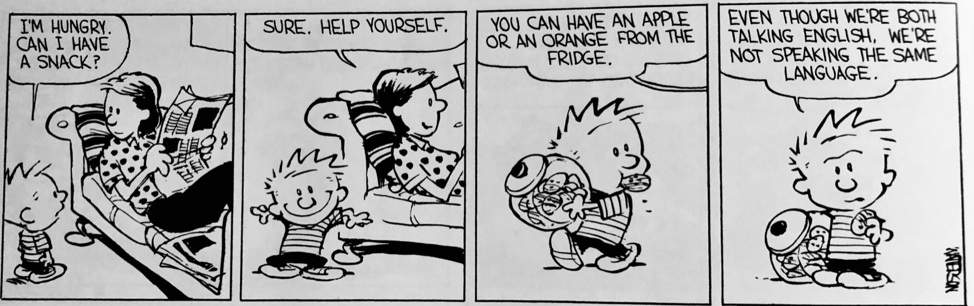


I’d love to meet you if you’ve never, in your lifetime, had a conversation with family, friends, or co-workers where one of you was not misunderstood or misheard. I am often asked by coaching clients“What is the most critical skill I need as a leader?” Regardless of their experience as a leader listening generally factors into my answer. I’d like to give you five ideas why we might hear what we want to hear versus what was actually said.
- Bias based on our experiences. As we listen to someone talking about a subject we know, our tendency is to mentally influence what we hear to align with our experience. This can result mixed messages as our brain is processing these two thought patterns in parallel.
- Verbal and non-verbal don’t line up. As someone is speaking, the message being delivered isn’t coordinated with how it’s being delivered. If you remember old movies, the audio doesn’t always match the video. When this happens, your brain is getting different signals and is spending time processing this discrepancy, rather than fully engaging in the conversation.
- Selective hearing. In many ways, this can be related to #1 above, but we tune in and out as the message is being delivered. Maybe you are not fully engaged because of the speaker’s presentation approach or style, or you are tired, or maybe you believe that multitasking is good choice.
- Desire to make ourselves heard. StephenR. Covey sums this up best by saying “Most people do not listen with the intent to understand; they listen with the intent to reply.” I find this occurs when people restate what has already been said, even if the original speaker made the point clear.
- Physical barriers. Some wonder why I include this in the list, and my rationale is that if you don’t speak up when you can’t hear clearly because the room is too large, sound doesn’t carry in the space, or the speaker is looking in a different direction, it contributes to your lack of focus.
Recognizing we don’t listen is the first step to hearing.When the reason why we don’t hear is identified, my clients work toward a solution for that particular instance. Then we look systemically to identify where else this may occur. Solutions obviously come in many forms, but the difference with coaching is to produce a sustainable change in action or behavior. In some instances, a simple restatement to confirm what you heard is sufficient. But obviously that can get a bit annoying or overwhelming if you are constantly playing back what you heard. Other avenues to pursue are to ask questions – this is very valuable when there is any possibility of misunderstanding what a word means. Clarifying questions should be the major focus, and non-judgmental. One person’s definition of something could, and usually is, different from another’s. This approach also allows all involved to feel a part of the discussion.
After poor listening, there are clearly other causes of miscommunication that exist. For instance, when you thought you shared the information with an individual or group, but you may in fact have only written it down to share, or perhaps mentioned to another individual or group. Sometimes, when we have an idea to share, we visualize how that conversation will go, which leads us to think the exchange actually happened.Any of these examples can lead to a lack of information shared and cause problems in both personal and professional relationships. The question is, do you give the person the benefit of the doubt that you didn’t convey the message, or do you stand firm that you did? Either decision you make could be accurate, depending on the situation, however, that course of action will be influenced by your objective or goal at the time.
These behaviors are all able to be overcome with perseverance. Small changes each day can lead to big changes over time. How will you take control of your personal improvement and be a model for those around you?